Law Firm Website Must-Haves in 2026: A Florida Checklist
By Jose Ibarra ·
Short answer: A Florida law firm website in 2026 needs to do six things well. It explains clearly who you help and with what. It makes contacting you fast and secure, in English and Spanish where your clients need it. It follows the Florida Bar's advertising rules, meets accessibility standards (WCAG 2.1 AA), loads fast on a phone, and is easy for both Google and AI search tools to understand. Bar rules and accessibility aren't optional extras; they're where firms get into trouble.
This post is about websites, not legal ethics advice. Check specific questions with the Florida Bar's Ethics and Advertising department.
1. Clear practice areas and who you serve
Visitors decide in seconds whether you handle their kind of problem. Give each practice area its own page that answers:
- What situations you handle, in plain language
- Where you practice: county, courts and cities
- What happens after someone contacts you
- Who the attorneys are, with bios and bar admissions
These pages are also what Google and AI tools quote when someone asks "family lawyer near me who speaks Spanish."
2. Fast, secure intake
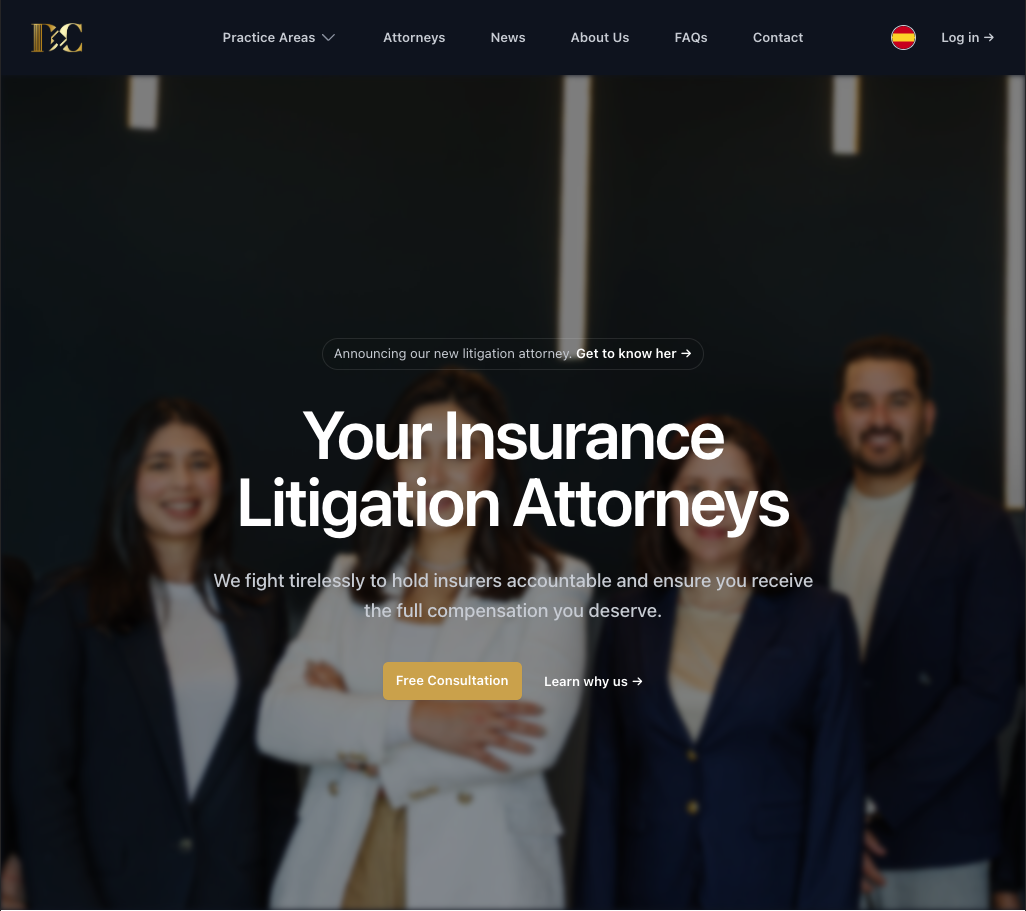
Intake is where your website earns its keep. The Law Office of Daniela Carmona site I built has a dedicated intake page with a secure form, so new clients can submit their case information directly to the firm.
Good intake in 2026 means:
- A short first step. Name, contact details, practice area and a brief description. Ask for details later.
- Spanish intake for South Florida. About three in four Miami-Dade residents speak a language other than English at home (U.S. Census QuickFacts).
- Spam protection like reCAPTCHA, so real inquiries don't drown in junk.
- A clear notice that submitting a form doesn't create an attorney-client relationship, and a warning not to send confidential details until you've confirmed representation.
- Fast routing to the right person, with an automatic confirmation to the client.
3. Florida Bar advertising compliance
Lawyer and law firm websites are exempt from the Florida Bar's filing requirement. They must still follow the substantive advertising rules: Rules 4-7.12 through 4-7.17 and 4-7.21 (Florida Bar website checklist, Florida Bar Advertising).
On a website, that means watching:
- The name requirement. Every advertisement must include the name of at least one lawyer or the law firm.
- Statements about results and quality. Claims must be objectively verifiable and not misleading. Be careful with past results, testimonials and words like "best" or "expert."
- Ads elsewhere. Your site may be exempt, but paid ads that point to it, like banner ads or boosted social posts, can have their own filing rules. The Bar's filing fees changed on July 1, 2026 (Florida Bar filing requirements).
The Florida Bar's Handbook on Lawyer Advertising and Solicitation is the reference to keep handy when writing site copy.
4. Accessibility
Website accessibility lawsuits are a real risk in Florida. Plaintiffs filed 3,117 website accessibility lawsuits in federal court in 2025, up 27% from 2024. Florida had 961 of them, almost double its 470 filings in 2024 (Seyfarth Shaw, ADA Title III). WCAG 2.1 AA is the standard plaintiffs most often point to (UsableNet).
Building accessibly from the start means:
- Real text, not text inside images
- Enough color contrast, and visible focus outlines for keyboard users
- Form fields with labels and clear error messages
- Captions for videos and descriptive alt text for images
- A site that works with a keyboard alone and with screen readers
A plugin that adds an "accessibility widget" doesn't fix an inaccessible site. The fixes have to be in the site itself.
5. Speed and mobile
Most people looking for a lawyer search on their phone, often at a stressful moment. Your site should load fast on mobile data, show your phone number and a contact button without scrolling, and never make someone pinch and zoom to read.
6. Ready for Google and AI search
People increasingly ask ChatGPT, Perplexity or Google's AI for lawyer recommendations. To be cited:
- Allow the AI search crawlers in your
robots.txt - Start each practice-area page with a direct, plain-language answer
- Keep your firm's name, address and phone number identical on your site, Google Business Profile and directories
- Publish helpful articles regularly. A news section your staff can update without a developer makes that realistic. The Carmona site includes one, plus a newsletter system.
I cover this in depth in How to Get Your Business Found in ChatGPT, Google AI Overviews and Perplexity.
The checklist
- One page per practice area, written in plain language
- Attorney bios with bar admissions
- Short, secure intake form with a no-relationship notice
- Spanish version of key pages and intake, if your clients need it
- Spam protection on every form
- Copy reviewed against Florida Bar Rules 4-7.12 to 4-7.17 and 4-7.21
- WCAG 2.1 AA accessibility, tested with a keyboard and screen reader
- Fast mobile load with phone and contact visible right away
- AI search crawlers allowed; consistent name, address and phone everywhere
- A news section your team can update
FAQ
Do Florida law firm websites have to be filed with the Florida Bar? No. Lawyer and law firm websites are exempt from the filing requirement, but they must still comply with the substantive advertising rules (4-7.12 through 4-7.17 and 4-7.21).
What must every Florida law firm website include? At minimum, the name of at least one lawyer or the law firm, plus truthful, verifiable content that follows the Bar's advertising rules.
Are law firms really sued over website accessibility? Any business with a public website can be. Florida saw 961 federal website accessibility lawsuits in 2025, the second-highest count of any state.
Should a Miami law firm website be bilingual? In most of Miami-Dade, yes. Most residents speak a language other than English at home, and Spanish intake removes a major barrier for new clients.
How do I get my firm recommended by ChatGPT or Google's AI? Make your practice-area pages clear and specific, allow AI search crawlers, keep your firm details consistent across the web and earn reviews and mentions on reputable sites.
I build websites and case-management tools for law firms in South Florida. See law firm websites in Miami or tell me about your firm.
Sources
- Quick Reference Checklist: Websites, The Florida Bar
- Handbook on Lawyer Advertising and Solicitation (2025), The Florida Bar
- Lawyer Advertising Filing Requirements, The Florida Bar
- Federal Court Website Accessibility Lawsuit Filings Bounce Back in 2025, Seyfarth Shaw
- 2025 Year-End Report on Web Accessibility Lawsuits, UsableNet
- QuickFacts: Miami-Dade County, Florida, U.S. Census Bureau